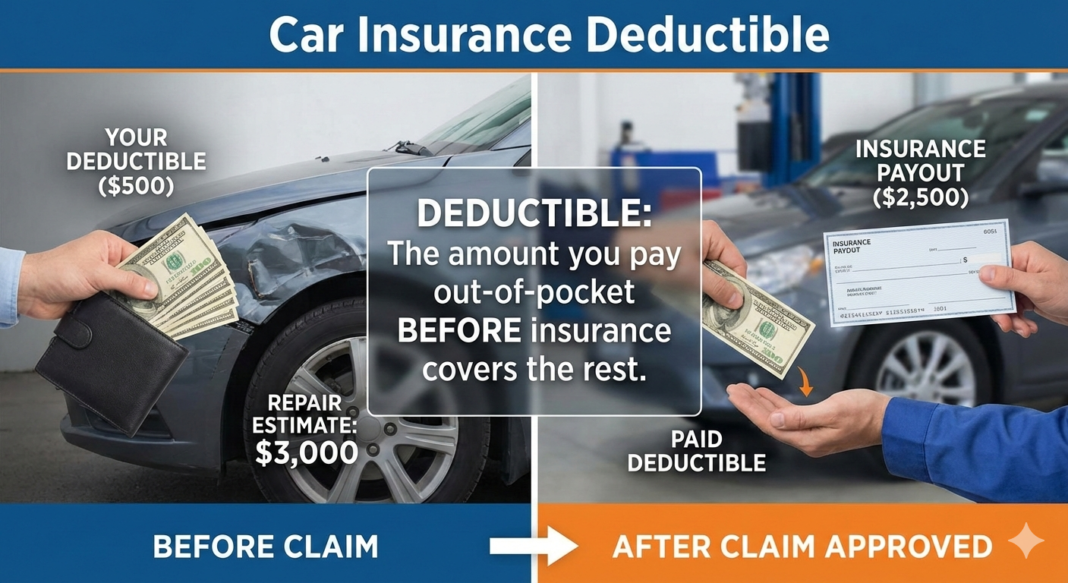

What Is a Deductible in Car Insurance?
If you’ve ever shopped for car insurance — whether online, through an agent, or by comparing quotes on an aggregator — you’ve almost certainly encountered the word deductible. It appears on every policy summary, every quote screen, every renewal notice. And yet, research consistently shows that a significant portion of policyholders don’t fully understand what it means until the moment they need to file a claim. By then, it’s too late to change it.
In the simplest possible terms: a deductible is the portion of any covered repair or loss that you agree to pay yourself before your insurance company contributes a single dollar. Think of it as your financial “skin in the game.” It’s the threshold your costs must cross before your policy activates.
📌 Plain-Language Definition
Deductible = Your share of the bill. If a covered repair costs $2,000 and your deductible is $500, you pay $500 and your insurer pays $1,500. The math never changes — only the numbers do.
This contrasts sharply with how many people intuitively imagine insurance works. It’s natural to assume that insurance “takes over” the moment something goes wrong. In reality, every collision and comprehensive claim begins with you absorbing the deductible amount. Your insurer then covers whatever remains — up to your coverage limits.
It’s also important to note that deductibles are applied per claim, not per year. Unlike health insurance, which often has an annual out-of-pocket maximum after which coverage kicks in at 100%, auto insurance deductibles reset with every new incident. File two separate claims in the same month, and you’ll owe your deductible twice.
📚 Learn More — Official & Authoritative Sources
- Insurance Information Institute — Collision & Comprehensive Explained The III is the gold-standard nonprofit source for insurance education in the United States.
- NAIC Consumer Resources — Auto Insurance Basics The National Association of Insurance Commissioners offers state-by-state guidance and consumer tools.
Section 02
Why Deductibles Exist — and Why They Benefit Everyone
Deductibles aren’t an arbitrary invention by insurance companies to reduce their costs (though they do accomplish that). They exist for legitimate, systemic reasons that ultimately benefit policyholders across the board. Understanding the “why” helps you think about deductibles not as a punishment, but as a financial design tool.
1. They Discourage Small, Frivolous Claims
Without a deductible, there would be a powerful incentive to file a claim for every minor scratch, small dent, or cracked windshield. The administrative overhead alone — claim intake, adjuster assignment, damage assessment, payment processing — costs insurers hundreds of dollars per claim, regardless of the damage amount. By requiring you to absorb small losses yourself, deductibles ensure that the insurance machinery is reserved for genuinely significant losses. This keeps the system efficient.
2. They Distribute Risk Fairly Between Driver and Insurer
Insurance is a risk-pooling mechanism. Everyone pays into a collective fund, and that fund covers catastrophic or unexpected losses. Deductibles define where your personal risk ends and the collective fund’s responsibility begins. A driver who selects a $1,000 deductible is essentially saying: “I’ll handle the first $1,000 of any incident myself.” This is a meaningful commitment — and it’s rewarded with lower premiums, because the insurer’s exposure is reduced.
3. They Reduce Moral Hazard
In economics, “moral hazard” describes the tendency to take greater risks when someone else bears the consequences. Full coverage with zero deductibles could theoretically make drivers less careful — knowing that any damage is entirely covered. Deductibles create a financial stake in safe driving. They align your interests with your insurer’s, because you both benefit from claim-free years.
4. They Make Premiums Affordable at Scale
Because deductibles filter out the high volume of small claims, insurers can price policies more competitively for catastrophic losses — the ones that truly threaten financial stability. Without deductibles, every minor fender-bender would be billed to the insurance pool, and premiums would rise dramatically to compensate. The deductible mechanism is, in large part, why auto insurance is accessible to middle-income households.
“The deductible is not a penalty — it is the price of transferring catastrophic risk to someone better equipped to absorb it.” Section 03
Types of Car Insurance Deductibles
One of the most persistent misconceptions about deductibles is that they apply universally across all car insurance coverages. In reality, deductibles are specific to certain coverage types — and understanding which ones require a deductible (and which don’t) is critical to reading your policy correctly.
Collision Deductible
Collision coverage pays for damage to your vehicle when it collides with another car or a stationary object — a guardrail, a telephone pole, a parking lot barrier, or even your own garage door. It also covers rollover accidents. Your collision deductible is the amount you pay out of pocket every time you file a collision claim.
Collision coverage is optional for drivers who own their vehicles outright. However, if your car is financed or leased, your lender or leasing company almost certainly requires it — and may specify a maximum allowable deductible (typically $500 or less). Always review your loan or lease agreement before adjusting this deductible.
Comprehensive Deductible
Comprehensive coverage is sometimes called “other than collision” coverage, which is an apt description. It covers damage to your vehicle from causes that aren’t traffic accidents: theft, vandalism, fire, flooding, hail, falling trees, and collisions with animals (deer strikes are a leading comprehensive claim). Your comprehensive deductible functions identically to your collision deductible — you pay it first, your insurer covers the rest.
Many drivers choose different deductible levels for collision vs. comprehensive. Because comprehensive events (floods, hail, deer) are often unpreventable and can be geographically concentrated, some policyholders prefer a lower comprehensive deductible even if they carry a higher collision deductible.
Uninsured/Underinsured Motorist Property Damage (UMPD)
Some states allow a deductible for uninsured motorist property damage coverage — the coverage that pays for your car’s repairs when an uninsured driver hits you. This deductible is usually modest (often $250 or $300), and in some states, it’s waived entirely if the at-fault driver can be identified. Rules vary significantly by state.
Coverages Without a Deductible
Critically, several core insurance coverages do not involve a deductible:
- Liability insurance — pays for damage or injuries you cause to others. You never pay a deductible on your own liability coverage.
- Personal Injury Protection (PIP) — covers medical expenses for you and your passengers, typically without a deductible (though some states allow a PIP deductible).
- Medical payments coverage (MedPay) — similar to PIP, usually no deductible.
- Uninsured motorist bodily injury — covers your medical costs if an uninsured driver injures you. Generally no deductible.
📚 Helpful External Resources
- III — Standard Auto Policy Coverage Breakdown A clear overview of what each coverage type covers and how they interact.
- FTC Consumer Guide — Auto Insurance The Federal Trade Commission’s consumer-focused overview of auto insurance.
Section 04
How Deductibles Work After an Accident — Real-World Scenarios
Theory is useful, but most people understand deductibles best through concrete examples. The following scenarios walk through the most common situations you’ll encounter — and what you’ll actually owe in each case.
Scenario A: At-Fault Accident (Using Your Own Coverage)
You rear-end another car at a stoplight. The other driver’s car is damaged, and so is yours. You are at fault. Your liability insurance covers the other driver’s repairs — no deductible applies on your end for that. But for your own vehicle, you file a collision claim. Here’s how the math works:
Your Repair Bill$4,000
Total cost to repair your vehicle
Your Deductible$750
You pay this directly to the repair shop
Insurance Pays$3,250
Insurer covers the balance
Scenario B: Not-At-Fault Accident — Using Your Own Policy
Another driver runs a red light and hits you. You’re clearly not at fault. You can either file a claim with their liability insurance (no deductible, but you’re at the mercy of their insurer’s timeline) or file with your own collision coverage for faster service. If you use your own collision coverage, you do pay your deductible upfront. However, your insurer will typically pursue the at-fault driver’s insurance for reimbursement — a process called subrogation — and return your deductible to you once it’s recovered. This can take weeks to months.
Scenario C: Not-At-Fault — Using the Other Driver’s Insurance
In the same scenario above, if you file directly with the at-fault driver’s liability insurer and they accept liability, you typically owe nothing out of pocket. Their insurer pays 100% of your vehicle repairs. No deductible, no subrogation wait. The downside: if the other insurer disputes fault or their coverage is insufficient, your claim could be delayed or underpaid.
Scenario D: Comprehensive Claim (Hail Damage)
A severe hailstorm leaves your car with extensive dents across the hood, roof, and trunk. You file a comprehensive claim. Your comprehensive deductible (which may differ from your collision deductible) applies. If the hail caused $3,800 in damage and your comprehensive deductible is $250, your insurer pays $3,550.
⚖️ Subrogation: How You Get Your Deductible Back
When you’re not at fault but use your own collision coverage, ask your insurer about subrogation rights. Your company will file a claim against the at-fault driver’s insurer to recover the amount they paid — including your deductible. If successful, you receive your deductible back. Track your claim’s subrogation status actively; it’s worth following up. Section 05
How Deductibles Affect Your Premium — The Core Trade-Off
The relationship between your deductible and your premium is one of the most direct financial levers available to you as a policyholder. It’s simple: raise your deductible and your premium falls; lower it and your premium rises. But the magnitude of this effect — and how to calculate whether a trade-off makes sense — is something most drivers have never worked through carefully.
Sample Premium Comparison
| Deductible | Est. Monthly Premium | Annual Premium | 5-Year Total |
|---|---|---|---|
| $250 | $165 | $1,980 | $9,900 |
| $500 | $138 | $1,656 | $8,280 |
| $1,000 | $110 | $1,320 | $6,600 |
| $1,500 | $96 | $1,152 | $5,760 |
| $2,000 | $85 | $1,020 | $5,100 |
Note: These are illustrative estimates. Actual premiums vary by state, driving record, vehicle type, age, and insurer. Always obtain a personalized quote.
The Break-Even Calculation
Before raising your deductible to save on premiums, calculate how long it takes for those savings to offset the higher out-of-pocket risk. This is called the break-even point.
Formula: Break-even (months) = (Higher Deductible − Lower Deductible) ÷ Monthly Premium Savings
Example: Switching from a $500 to a $1,000 deductible saves $28/month ($138 − $110). The additional deductible exposure is $500. Break-even = $500 ÷ $28 = 17.9 months. If you go 18+ months without a claim, you’ve come out ahead. If you file a claim within those 18 months, you’ve lost money on the switch.
📚 Tools to Calculate Your Own Premium
- NerdWallet — Car Insurance Comparison Tool Compare real quotes across multiple insurers and see how deductible choices affect your rate in real time.
- PolicyGenius — Auto Insurance Quotes Independent quote comparison platform with detailed coverage explanations.
Section 06
How to Choose the Right Deductible for Your Situation
There is no universally “correct” deductible amount. The right choice depends on a careful assessment of your financial situation, driving habits, vehicle value, and risk tolerance. Here’s a structured framework for making this decision.
Question 1: Could You Pay Your Deductible Tomorrow?
This is the single most important question. Accidents don’t wait for a convenient financial moment. If your car were totaled or severely damaged tomorrow morning, how quickly could you come up with $1,000? $500? $250? If the answer is “not easily,” your deductible is too high. A deductible only works as financial protection if you can actually deploy the funds immediately. A high deductible you can’t pay is worse than no deductible at all — your car sits unrepaired, and you may face issues with your insurer or repair shop.
Financial advisors generally recommend maintaining an emergency fund equal to at least your insurance deductible (auto, home, and health) as a minimum cash reserve. If you have $2,000 saved, a $1,000 deductible is reasonable. If you have $400 saved, keep your deductible at $250 or lower.
Question 2: How Often Are You Likely to File a Claim?
Your personal claims history and driving environment are strong predictors of future claim frequency. Drivers who commute long distances in heavy urban traffic are statistically more likely to be involved in accidents than those who drive rarely in rural areas. If you file a claim every 3–4 years on average, a lower deductible may serve you better. If you’ve been claim-free for 8+ years, a higher deductible rewards you with lower premiums for that clean record.
Question 3: What Is Your Vehicle’s Current Market Value?
The value of your car sets a ceiling on the insurance payout. If your car is worth $5,000 and you carry a $2,000 deductible, you’re paying out of pocket for a very large fraction of any possible claim. At a certain point — typically when the deductible exceeds 10–15% of the vehicle’s value — the math stops working in your favor, and you should consider dropping collision coverage entirely and self-insuring.
Choose a Higher Deductible When…
- You have 3+ months of expenses saved
- Clean driving record (5+ claim-free years)
- Car is newer, higher value
- Low annual mileage / rural driving
- You want to minimize monthly costs
- You have stable, predictable income
Choose a Lower Deductible When…
- Emergency savings are limited
- Frequent prior claims or incidents
- Heavy urban / highway commuting
- Leased or financed vehicle (often required)
- Recent driver or teen on policy
- Living in a high-theft area
Section 07
Deductibles and Older or Low-Value Cars
One of the most financially costly mistakes drivers make is maintaining full collision and comprehensive coverage — with low deductibles — on vehicles that have significantly depreciated in value. The math can turn actively against you well before the car reaches the end of its useful life.
Here’s the core issue: insurance companies pay out based on the vehicle’s Actual Cash Value (ACV) — essentially its fair market value at the time of the loss, accounting for depreciation, mileage, condition, and comparable sales. If your car is worth $4,500 and your deductible is $1,000, the maximum you could ever receive from a total loss claim is $3,500. Is that worth paying for year after year?
The 10% Rule (A Practical Guideline)
A commonly used rule of thumb: if your annual collision and comprehensive premiums exceed 10% of your vehicle’s ACV, consider dropping those coverages. Example: if your car is worth $5,000 and you’re paying $600/year for collision and comprehensive, that’s 12% — above the threshold. You may be better off self-insuring and banking the premium savings.
🔍 How to Find Your Car’s ACV
Use tools like Kelley Blue Book or Edmunds to estimate your vehicle’s current market value. Compare this against your annual collision/comprehensive premium plus your deductible to decide whether continued coverage makes financial sense. Section 08
Deductibles in Total Loss Claims
When your vehicle is declared a total loss — meaning the cost to repair it exceeds its Actual Cash Value, or repair isn’t feasible — the claim process differs somewhat from standard repairs, but your deductible still applies.
In a total loss scenario, your insurer pays you the ACV of the vehicle, minus your deductible. If your car is worth $14,000 and your deductible is $1,000, you receive $13,000. You’re responsible for clearing any outstanding loan balance; if you owe more than $13,000, you face a “gap” — which is precisely why GAP insurance exists.
Understanding GAP Insurance
GAP (Guaranteed Asset Protection) insurance covers the difference between your vehicle’s ACV payout and the remaining balance on your auto loan or lease — a gap that commonly exists on new vehicles in the first 2–3 years of ownership. Some GAP policies also cover your deductible. If you financed a new vehicle recently, GAP coverage is worth serious consideration.
📚 Further Reading on Total Loss & GAP
- III — What Happens When Your Car Is a Total Loss Step-by-step explanation of the total loss process from the Insurance Information Institute.
- CFPB — What Is GAP Insurance? The Consumer Financial Protection Bureau’s explainer on GAP coverage.
Section 09
Special Deductible Situations
Glass and Windshield Claims
Glass damage is one of the most common claims in auto insurance, and many states have enacted specific rules governing it. In Florida, Kentucky, and South Carolina, comprehensive claims for glass repair or replacement are processed with zero deductible — meaning you pay nothing for a cracked windshield, by law. In other states, your standard comprehensive deductible applies. Some insurers offer optional glass coverage endorsements with a $0 deductible. Check your policy and state regulations carefully; this is an area where a small policy change can save you hundreds.
Hurricane and Named Storm Deductibles
In coastal and hurricane-prone states (Florida, Texas, Louisiana, and others), vehicle policies may include a separate, higher deductible for damage caused by named storms or hurricanes. These are sometimes expressed as a flat dollar amount, but can also be calculated as a percentage of the vehicle’s value — meaning your effective deductible rises with your car’s worth. Read the fine print if you live in an at-risk area.
Rental Car Deductibles
If your insurer provides rental car reimbursement as part of your policy, you typically don’t face a deductible for that benefit. However, if you’re renting a car and purchase coverage from the rental company, their collision damage waiver (CDW) functions like a zero-deductible policy for the rented vehicle. Some credit cards and personal auto policies already cover rental cars — eliminating the need to purchase CDW.
📚 State-Specific Insurance Resources
- NAIC — Find Your State Insurance Department Each state regulates insurance differently. Your state’s commissioner website has local rules on glass, deductibles, and minimum coverage.
Section 10
Common Myths About Car Insurance Deductibles
Misinformation about deductibles is widespread — even among experienced drivers. Here are the most persistent myths, debunked.
❌ Myth “A lower deductible is always the smarter choice.”
✅ Fact A lower deductible increases your monthly premium. For drivers with strong emergency funds and clean driving records, a higher deductible is often the better financial decision. It’s a personal finance calculation, not a universal rule.
❌ Myth “My deductible applies to all my insurance coverages.”
✅ Fact Deductibles only apply to collision and comprehensive coverage (and in limited cases, UMPD). Liability, PIP, and uninsured motorist bodily injury have no deductible. You never pay a deductible on claims filed against your liability coverage.
❌ Myth “My insurance pays first, and I reimburse them later.”
✅ Fact The deductible is paid first — directly to the repair shop. Your insurer pays only the remaining amount. Some shops allow deductible financing, but your insurer does not cover it in advance.
❌ Myth “If I wasn’t at fault, I don’t owe a deductible.”
✅ Fact If you use your own collision coverage (even when not at fault), you pay your deductible upfront. You may recover it later through subrogation if your insurer is able to collect from the at-fault party — but there are no guarantees or timelines.
❌ Myth “Insurers can waive my deductible if I ask nicely.”
✅ Fact Standard insurance contracts do not permit deductible waivers on demand. If an insurer or repair shop offers to “waive” your deductible without documentation, this is likely insurance fraud — a serious crime that can result in policy cancellation and legal liability. Section 11
Deductibles and Claim Decisions — When NOT to File
Understanding deductibles isn’t just about knowing what you owe — it’s about knowing when filing a claim is a rational decision at all. Every claim you file carries potential consequences beyond the deductible itself: possible premium increases, loss of accident forgiveness benefits, and in some cases, non-renewal risk. These downstream costs often outweigh the immediate payout.
The True Cost of Filing a Small Claim
Suppose you have a $500 deductible and your fender was dinged for $700 in damage. You file a claim and your insurer pays $200 — not much. But if your insurer raises your premium by $15/month for the next 3 years as a result, you’ve paid an additional $540 over that period. Your total cost of that $700 repair: $500 (deductible) + $540 (premium increase) = $1,040 — more than the repair itself.
General Guidance: Pay Out of Pocket When…
- The damage cost is close to or below your deductible
- The damage is only slightly above your deductible (consider premium impact)
- You’ve already filed a claim in the past 12–24 months
- Your insurer has a surcharge schedule that significantly penalizes minor claims
- The damage is cosmetic and doesn’t affect vehicle safety or value significantly
📚 Tools to Help You Decide
- CARFAX — Vehicle Value & History Check your car’s value and history to inform decisions about whether to claim or self-pay.
- RepairPal — Auto Repair Cost Estimator Get fair repair cost estimates before deciding whether a claim is worth filing.
Section 12
Vanishing Deductibles and Deductible Reward Programs
Several major insurers now offer programs that reduce your deductible over time as a reward for claim-free driving. These go by various names — vanishing deductibles, deductible rewards, diminishing deductibles — and they represent a meaningful benefit for safe drivers.
Typically, these programs work by crediting you a fixed amount (often $50–$100) against your deductible for every claim-free policy year. After five consecutive clean years, for example, your effective deductible could be reduced by $250–$500 from its original level. Some programs offer an immediate reduction upon enrollment, with continued reductions in subsequent years.
Nationwide’s “Vanishing Deductible” program is one of the best known, but similar offerings exist at Progressive, Liberty Mutual, and others. These programs are not free — they’re typically added as a policy endorsement with an additional premium — so you should calculate whether the expected benefit over your anticipated claim-free years justifies the additional monthly cost.
📚 Insurer Programs Worth Exploring
- Nationwide — Vanishing Deductible Explained Official details on one of the most established deductible reward programs in the market.
- Progressive — Deductible Savings Bank Progressive’s version of the program and how credits are applied to claims.
Section 13
Deductibles for Leased or Financed Vehicles
When you don’t own your vehicle outright — whether it’s financed through a bank or credit union, or leased from a dealership — you don’t have complete freedom to set your own deductible. Lenders and lessors have a financial interest in your vehicle and routinely impose insurance requirements as a condition of the loan or lease agreement.
Most lenders require both collision and comprehensive coverage, with deductibles no higher than $500 (sometimes $1,000). Violating these terms — by carrying a $2,000 deductible when your contract specifies a $500 maximum — puts you in breach of contract. In the event of a serious accident, your lender may have grounds to force-place insurance on your behalf (at your expense) or take other remedial action.
Always read the insurance requirements section of your financing or leasing contract before selecting or modifying your deductible. If you’re unsure, call your lender directly before adjusting your policy. Section 14
Final Summary: What a Deductible Really Means for You
A car insurance deductible is not merely a technical line item on your policy document — it’s a fundamental financial decision that shapes how your insurance actually performs when you need it most. Getting it right requires honest self-assessment about your emergency fund, your risk tolerance, your driving environment, and the value of the vehicle you’re insuring.
The core insight is this: there is no universally correct deductible. A $1,000 deductible might be brilliant for a high-income driver with $10,000 in savings and a spotless record. The same deductible could be financially ruinous for someone living paycheck to paycheck. The decision is deeply personal — and it deserves more than a few seconds of thought when you’re buying or renewing a policy.
Review your deductible annually. As your financial situation improves — as your emergency fund grows, as your car ages and depreciates — the optimal deductible changes. Insurance is not a “set it and forget it” product. It rewards attentive policyholders.
✦ Key Takeaways
- A deductible is what you pay before your insurer pays — it applies per claim, not per year
- Deductibles apply to collision and comprehensive coverage; liability has no deductible
- Higher deductible = lower monthly premium — but greater financial risk per incident
- Never set a deductible higher than you could pay immediately from savings
- Calculate the break-even point before changing your deductible to save on premiums
- On older, low-value cars, dropping collision coverage may make more sense than carrying a high deductible
- Not-at-fault drivers may recover their deductible through subrogation — follow up with your insurer
- Consider vanishing deductible programs if you have a clean record and want long-term savings
- Review your deductible every policy year — your situation changes, and so should your coverage
This article is intended for informational purposes only and does not constitute legal or financial advice. Insurance products, regulations, and pricing vary by state and insurer. Always consult your insurance agent or a licensed professional before making coverage decisions.
Further Resources: Insurance Information Institute · NAIC · CFPB