
If you’ve ever shopped for car insurance, you’ve probably seen the word deductible and wondered what it really means — and why choosing the wrong one can cost you hundreds or even thousands of dollars.
A deductible is one of the most important yet misunderstood parts of car insurance. It directly affects:
- How much you pay out of pocket after an accident
- How much your monthly or annual premium costs
- Whether filing a claim even makes sense
This guide explains everything you need to know about car insurance deductibles, in simple language, with real-world examples.
What Is a Deductible in Car Insurance? (Simple Definition)
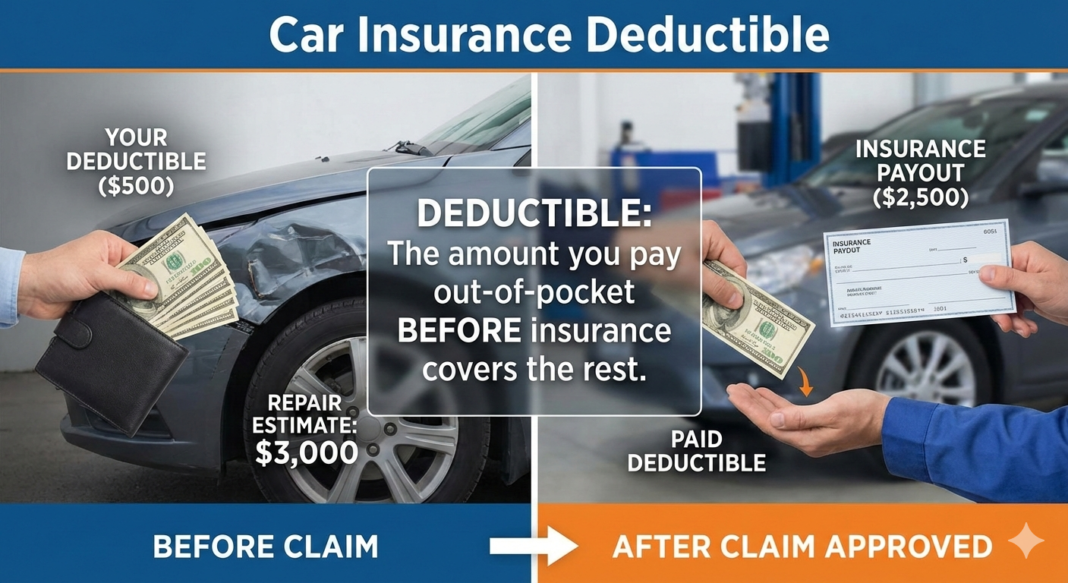
A deductible is the amount of money you must pay out of pocket before your car insurance company pays the rest of a covered claim.
In plain terms:
The deductible is your share of the repair bill.
Example:
- You have a $500 deductible
- Your car repair costs $2,000
- You pay $500
- Your insurance company pays $1,500
Why Deductibles Exist in Car Insurance
Insurance is designed to cover significant financial loss, not every minor expense.
Deductibles exist to:
- Prevent small, unnecessary claims
- Share risk between the driver and the insurer
- Keep insurance premiums affordable
Without deductibles, insurance costs would be much higher for everyone.
Types of Car Insurance Deductibles
Not all car insurance coverages use deductibles. Understanding where deductibles apply is critical.
1️⃣ Collision Deductible
A collision deductible applies when your car is damaged in an accident involving:
- Another vehicle
- A stationary object (tree, pole, guardrail)
- A rollover accident
📌 Collision coverage is optional unless required by a lender.
2️⃣ Comprehensive Deductible
A comprehensive deductible applies to damage caused by non-collision events, such as:
- Theft
- Vandalism
- Fire
- Floods
- Hurricanes
- Falling objects
- Animal collisions (deer, dogs)
📌 Comprehensive coverage is optional but strongly recommended.
3️⃣ No Deductible Coverages
Some car insurance coverages do not require a deductible, including:
- Liability insurance
- Uninsured/underinsured motorist bodily injury
- Personal injury protection (PIP) in many states
These coverages pay others — not your vehicle repairs.
How Deductibles Work After an Accident
Let’s walk through real-life scenarios.
Scenario 1: At-Fault Accident
- Repair cost: $3,000
- Deductible: $1,000
- You pay: $1,000
- Insurance pays: $2,000
Scenario 2: Not At-Fault Accident (Your Policy)
If you use your own collision coverage:
- You still pay your deductible
- Your insurer may later recover it from the at-fault driver (subrogation)
Scenario 3: Not At-Fault Accident (Other Driver’s Insurance)
If the other driver’s insurance pays:
- You typically do not pay a deductible
How Deductibles Affect Your Insurance Premium
There is a direct relationship between deductibles and premiums.
Higher Deductible = Lower Premium
- You pay more if an accident happens
- You save money every month
Lower Deductible = Higher Premium
- Less out-of-pocket after an accident
- Higher monthly cost
Example Comparison
| Deductible | Monthly Premium |
|---|---|
| $250 | $160 |
| $500 | $135 |
| $1,000 | $105 |
Choosing a deductible is about risk tolerance, not “cheap vs expensive.”
Common Deductible Amounts
Most insurance companies offer these deductible options:
- $250
- $500
- $1,000
- $1,500
- $2,000
The most common choice is $500, balancing affordability and risk.
How to Choose the Right Deductible
Ask yourself three key questions:
1️⃣ Can You Afford the Deductible Today?
If you had an accident tomorrow, could you pay the deductible immediately?
If not, choose a lower deductible.
2️⃣ How Often Do You File Claims?
- Frequent claims → lower deductible
- Rare claims → higher deductible
Drivers with clean records benefit more from higher deductibles.
3️⃣ What Is Your Car Worth?
- New or expensive car → lower deductible
- Older, low-value car → higher deductible or no coverage
Deductibles and Older Cars
If your car’s value is low, a deductible may not make sense.
Example:
- Car value: $3,000
- Deductible: $1,000
After an accident:
- Insurance payout is limited
- Claim may not be worth filing
In some cases, dropping collision coverage is smarter.
Deductible vs Premium: Long-Term Cost Comparison
Let’s compare two drivers over five years:
Driver A
- $500 deductible
- $150/month premium
- Total premiums: $9,000
Driver B
- $1,000 deductible
- $115/month premium
- Total premiums: $6,900
Driver B saves $2,100 — but risks paying more after an accident.
What Happens If You Can’t Pay Your Deductible?
If you can’t pay your deductible:
- Repairs may be delayed
- Repair shops may refuse work
- You may need payment plans
Insurance companies do not waive deductibles (except in rare promotions).
Are Deductibles Paid Per Accident?
Yes. Deductibles apply per claim, not per year.
If you have:
- Two separate accidents
- Two deductibles
Deductibles and Total Loss Claims
If your car is declared a total loss:
- Insurance pays the car’s actual cash value
- Deductible is subtracted from the payout
Example:
- Car value: $12,000
- Deductible: $1,000
- Payout: $11,000
Deductible vs Out-of-Pocket Maximum (Important Difference)
Car insurance does NOT have an out-of-pocket maximum like health insurance.
Your deductible:
- Applies every time
- Has no yearly cap
Can You Change Your Deductible?
Yes. You can change your deductible:
- At renewal
- Mid-policy (sometimes)
Changes affect your premium immediately.
Deductibles and Leased or Financed Cars
If your car is leased or financed:
- Lenders often require deductibles of $500 or less
- Higher deductibles may violate loan terms
Always check your contract.
Special Deductible Situations
Glass Claims
Some insurers:
- Offer $0 glass deductible
- Apply full comprehensive deductible
Depends on your policy and state.
Hurricane or Flood Deductibles
In disaster-prone states:
- Deductibles may apply differently
- Some policies use percentage deductibles
Myths About Car Insurance Deductibles
❌ Myth: “Lower deductible is always better”
✔ Truth: It depends on your finances and driving habits.
❌ Myth: “Deductibles apply to liability”
✔ Truth: Liability has no deductible.
❌ Myth: “Insurance pays first”
✔ Truth: You pay first, insurer pays the rest.
Deductibles and Claim Decisions
Sometimes not filing a claim is smarter.
If:
- Damage cost ≈ deductible
- Risk of premium increase exists
Paying out of pocket may save money long-term.
Deductible Waivers and Promotions
Some insurers offer:
- Accident forgiveness
- Vanishing deductibles
- Deductible rewards
These reduce deductibles over time but don’t eliminate them entirely.
How Deductibles Affect Insurance Claims History
Filing claims:
- Can increase premiums
- Can affect renewals
Higher deductibles reduce claim frequency.
Deductibles Explained for First-Time Drivers
New drivers should:
- Avoid extremely high deductibles
- Choose predictable monthly costs
- Build emergency savings
Deductibles and Insurance Fraud (Why It Matters)
Deductibles:
- Reduce fraudulent claims
- Discourage inflated repair costs
- Protect insurance pools
They help keep premiums stable for everyone.
Quick Deductible Decision Guide
| Situation | Recommended Deductible |
|---|---|
| New car | $250–$500 |
| Older car | $1,000+ |
| Limited savings | Lower |
| Emergency fund | Higher |
| Frequent claims | Lower |
| Rare claims | Higher |
Final Summary: What a Deductible Really Means
A car insurance deductible:
- Is the amount you pay before insurance pays
- Applies to collision and comprehensive coverage
- Directly impacts your premium
- Should match your financial comfort level
Choosing the right deductible is about balance, not cost alone.
Key Takeaways
- Deductibles are not “bad” — they control costs
- Higher deductible = lower premium
- Lower deductible = higher monthly cost
- Always choose what you can afford today, not “later”