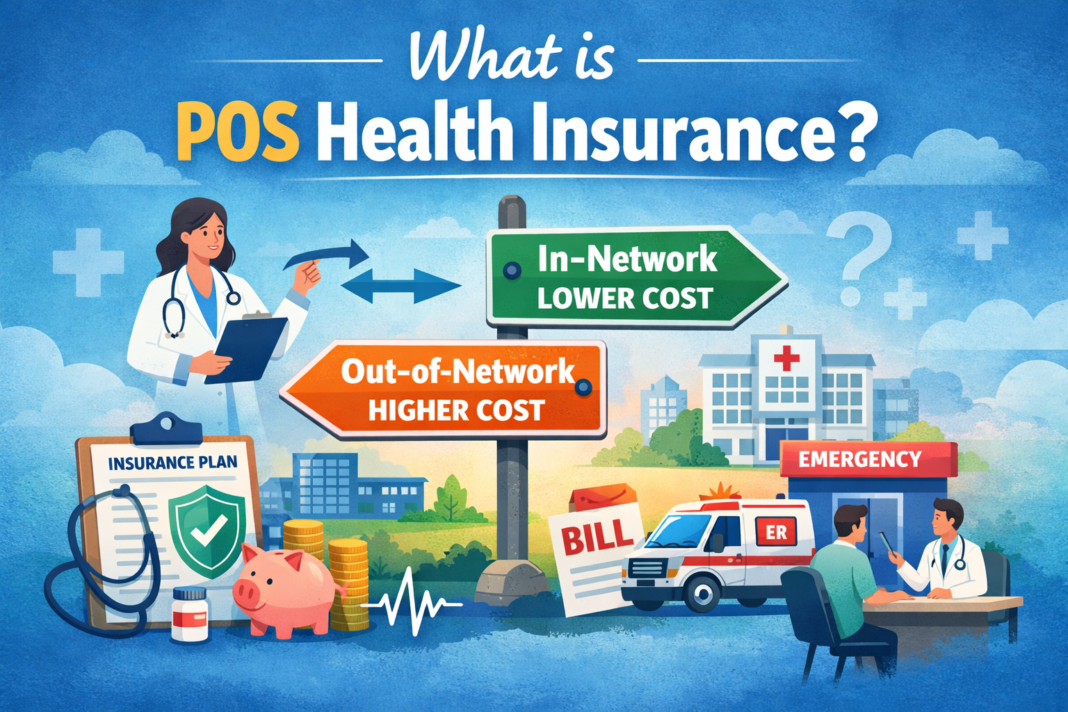

Discover how a Point of Service (POS) plan blends the structure of an HMO with the flexibility of a PPO — and whether it’s the right health coverage choice for you and your family.
What Is a POS Health Insurance Plan?
Definition
A Point of Service (POS) plan is a type of managed care health insurance that combines the structured care coordination of a Health Maintenance Organization (HMO) with the provider flexibility of a Preferred Provider Organization (PPO). Each time you need care, you choose — at the “point of service” — whether to stay in-network or seek care outside the network.
POS stands for Point of Service. The name reflects a core feature: every time you seek medical care, you make a decision at that moment about how to access it. You can use your in-network providers for lower costs, or you can step outside the network and pay more — the choice is yours.
This hybrid structure makes POS plans a compelling middle-ground option for people who want coordinated care but don’t want to feel completely restricted by a rigid provider network.
How Does POS Health Insurance Work?
Understanding how a POS plan operates day-to-day is key to making the most of your coverage. Here’s a step-by-step breakdown of the process:
1
Choose a Primary Care Physician (PCP)
When you enroll, you select a Primary Care Physician from the plan’s in-network list. Your PCP becomes your main point of contact for all routine health needs and acts as a gatekeeper for specialist care.
2
Visit Your PCP for Routine Care
For most health concerns, your first stop is your PCP. Staying in-network means you’ll pay only a small copay, and your insurer covers the rest at the highest benefit level.
3
Get a Referral for Specialists
If you need to see a specialist (like a cardiologist or dermatologist), your PCP issues a referral. This referral ensures you receive the highest level of coverage and helps keep your care coordinated.
4
Decide: In-Network or Out-of-Network?
At every point of service, you can choose. In-network visits are affordable; out-of-network visits are covered but at a reduced rate. Emergency care is always covered regardless of network status.
5
File Claims for Out-of-Network Visits
When you see an out-of-network provider, you may need to pay upfront and then submit a reimbursement claim to your insurance company. In-network claims are typically filed automatically by the provider.
In-Network vs. Out-of-Network Coverage
One of the defining features of a POS plan is that it covers both in-network and out-of-network care — but at very different cost levels. Here’s what you need to know:
In-Network Care
When you see a doctor or visit a hospital that is part of your POS plan’s network, you benefit from pre-negotiated rates between your insurer and the provider. This means:
- Lower copays (often $20–$40 per visit)
- Lower or no deductible before coverage kicks in
- Claims filed automatically on your behalf
- The highest level of insurance coverage
Out-of-Network Care
Seeing a provider outside your plan’s network is allowed — which sets POS apart from a standard HMO — but comes at a cost:
- Higher deductibles apply before coverage begins
- Greater coinsurance (you pay a larger percentage)
- You may need to pay upfront and request reimbursement
- Reimbursements are often limited by Medicare-based rates
💡 Key Takeaway: Emergency care is always covered at in-network rates under federal rules, regardless of where you receive treatment. You will never be left without coverage in a medical emergency.
POS Health Insurance: Pros and Cons
Like every health insurance plan, a POS plan comes with both advantages and drawbacks. Here’s an honest breakdown to help you decide:
✅ Advantages
- Flexible provider choice — in or out of network
- Lower premiums than most PPO plans
- Coordinated care through a dedicated PCP
- Nationwide coverage in most plans
- Annual out-of-pocket maximums protect you from catastrophic costs
- Emergency care always covered in full
- Ideal for frequent travelers
⚠️ Disadvantages
- Referrals required for specialist visits
- Out-of-network care is significantly more expensive
- Must file claims manually for out-of-network care
- More paperwork than HMO or PPO plans
- Higher premiums than basic HMO plans
- Complex coverage rules can be confusing
- Less common — fewer plan options available
POS vs. HMO vs. PPO: Key Differences
Choosing the right plan type often comes down to comparing POS, HMO, and PPO side by side. Here’s a comprehensive comparison:
| Feature | POS Plan | HMO Plan | PPO Plan |
|---|---|---|---|
| Primary Care Physician Required | Yes | Yes | No |
| Referrals for Specialists | Usually required | Required | Not required |
| Out-of-Network Coverage | Yes (higher cost) | No (emergency only) | Yes (higher cost) |
| Monthly Premium Cost | Moderate | Lower | Higher |
| Out-of-Pocket Costs (In-Network) | Low | Lowest | Moderate |
| Flexibility of Provider Choice | Moderate | Low | High |
| National/Travel Coverage | Yes | Limited | Yes |
| Claims Filing (out-of-network) | Self-filing required | N/A | Self-filing required |
Who Should Choose a POS Health Insurance Plan?
A POS plan isn’t right for everyone — but for certain individuals and families, it can be an excellent fit. Consider a POS plan if you:
✈️ Travel frequently for work or leisure — POS plans typically provide nationwide coverage, giving you access to care wherever you are in the country.
👨⚕️ Already have a trusted Primary Care Physician — If you have a long-standing relationship with your doctor, a POS plan can preserve that relationship while offering flexibility.
💰 Want lower premiums than a PPO — POS plans offer many of the same flexible benefits as a PPO but usually at a lower monthly premium.
🏥 Occasionally need out-of-network specialists — Unlike an HMO, a POS plan won’t leave you uncovered if your preferred specialist is outside the network.
👪 Have a family with mixed healthcare needs — A POS plan allows different family members to use different types of providers while keeping coordinated care at the center.
Who Might Prefer a Different Plan?
A POS plan may not be the best choice if you want complete freedom to see any specialist without a referral (consider a PPO), or if you want the lowest possible premiums and rarely need out-of-network care (an HMO may serve you better).
Understanding POS Plan Costs
Health insurance costs can be confusing. Here are the key cost components of a POS plan you need to understand:
Monthly Premium
This is the fixed amount you pay every month to maintain your coverage, regardless of whether you use your insurance. POS premiums are generally lower than PPO premiums but slightly higher than HMO premiums.
Deductible
Most POS plans have little or no deductible for in-network visits. However, out-of-network visits typically trigger a separate, higher deductible before your insurance begins to pay.
Copay
A copay is a fixed amount (e.g., $25) you pay at the time of an in-network visit. POS copays are generally affordable and predictable for routine care.
Coinsurance
After meeting your deductible for out-of-network care, you’ll still pay a percentage of the bill (coinsurance). This is typically higher for out-of-network services than in-network ones.
Out-of-Pocket Maximum
POS plans set an annual cap on how much you’ll pay for covered services. Once you hit this limit, your insurance covers 100% of the costs for the rest of the year — a critical safety net for those with serious health needs.
Frequently Asked Questions About POS Health Insurance
Q What does POS stand for in health insurance?
A POS stands for Point of Service. It refers to a type of managed care health plan that allows members to choose — at the point of needing care — whether to use in-network providers (for lower costs) or out-of-network providers (at a higher cost).
Q Do I need a referral to see a specialist with a POS plan?
A In most cases, yes. POS plans typically require your Primary Care Physician to issue a referral before you can see a specialist at the in-network coverage level. If you go out-of-network, you can still receive care, but at higher out-of-pocket costs.
Q Is a POS plan more affordable than a PPO plan?
A Generally, yes. POS plans tend to have lower monthly premiums than PPO plans. However, if you frequently need out-of-network care, your total annual costs on a POS plan could end up comparable to a PPO. Evaluate how often you use out-of-network providers before choosing.
Q Can I see any doctor with a POS plan?
A Yes, within limits. You can see any doctor — in-network or out-of-network — but in-network providers are significantly more affordable. For out-of-network doctors, you will pay higher deductibles and coinsurance, and may need to file your own reimbursement claim.
Q Is emergency care covered out-of-network on a POS plan?
A Yes. Under federal rules, emergency care must be covered at in-network levels, even if the emergency room or physicians are outside your plan’s network. You will never be left without coverage in a genuine medical emergency.
Q What is an HMO-POS plan?
A An HMO-POS plan is an HMO plan with added Point of Service benefits. It works like a standard HMO for in-network care — requiring a PCP and referrals — but adds the flexibility of allowing out-of-network care at a higher cost. Ideal for people who want HMO pricing but occasionally need care outside the network.